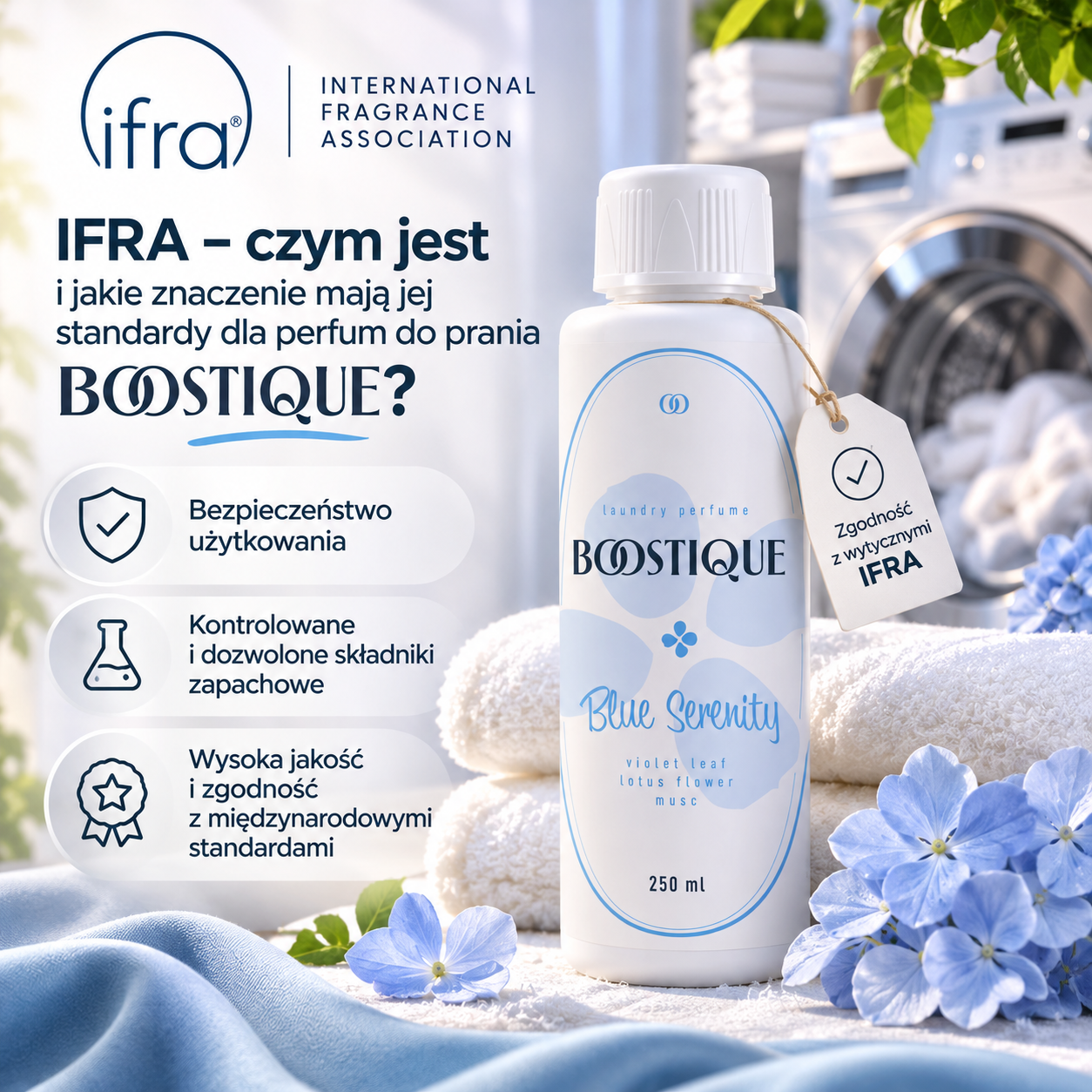
What is IFRA, and what do its standards mean for BOOSTIQUE laundry perfumes?
When choosing a laundry perfume, we usually notice the scent first. It might be fresh, floral, creamy or woody. We also want to know how intense it is, how long it lasts and how our favourite fragrance smells on clothes and bedding. Developing a fragranced product also involves understanding the properties of its ingredients, their concentrations and how people will use the finished product.
IFRA develops standards that are an important reference for the fragrance industry. What does compliance with IFRA Standards mean? Does an ‘IFRA certificate’ cover an entire brand? How do the standards apply to concentrated laundry perfumes, and why should you still follow the instructions on the label?
Using products such as BOOSTIQUE laundry perfumes, we explain what IFRA Standards mean for people who enjoy fragrance and for the teams that develop product formulas.
What is IFRA?
IFRA stands for the International Fragrance Association. It develops standards for the use of fragrance ingredients to help manage risks associated with specific applications.
The standards can restrict or prohibit the use of certain ingredients, or set conditions for their use in consumer products. Fragrance quality, luxury positioning, intensity and longevity fall outside the scope of these standards.
For anyone buying a laundry perfume, the practical point is that a fragrance mixture must be suitable for its intended application. The ingredients and intended use determine where and at what concentration the mixture can be used.
How are IFRA Standards developed?
The system draws on scientific research and assessments. The Research Institute for Fragrance Materials (RIFM) plays an important role in studying fragrance ingredients.
RIFM analyses the available data and assesses consumer exposure under real-world conditions of use. Its assessments consider potential skin sensitisation, phototoxicity and other effects relevant to human health and the environment. An independent expert panel reviews the findings.
If the assessment identifies a need for measures to reduce risk, IFRA develops an appropriate standard. The process includes consultation, during which additional scientific data can be submitted. IFRA then publishes the standards, which are implemented according to a set timetable.
As scientific knowledge develops, the rules can change. This makes periodic reviews of fragrance documentation necessary.
What exactly do IFRA Standards cover?
IFRA distinguishes between three main types of standards.
| Type of standard | What it means |
|---|---|
| Prohibition | Prohibits the use of a particular ingredient within the scope of the standard. |
| Restriction | Sets the permitted concentration or conditions of use for an ingredient in specific applications. |
| Specification | Sets additional requirements, such as those relating to the purity of a raw material. |
Some fragrance ingredients have no individual IFRA Standard. Their use still needs to be assessed, and the finished product must comply with applicable law.
In practice, fragrance developers need to consider the full formula. Both the choice of ingredients and their relative proportions matter.
Is compliance with IFRA Standards a legal requirement?
IFRA Standards are an industry framework that operates alongside applicable legislation. Compliance is mandatory for IFRA members under the IFRA Code of Practice. The standards do not constitute a regulation that applies to every manufacturer.
A company placing a product on the market must also meet legal requirements for its composition, classification and labelling, along with any other applicable obligations. Compliance with IFRA Standards is one part of this process.
Two questions are relevant when assessing a laundry perfume. Is the fragrance mixture used in accordance with IFRA Standards? Does the finished product meet all requirements for its category and the market where it is sold?
What is an ‘IFRA certificate’?
The commonly used term ‘IFRA certificate’ usually refers to the Certificate of Conformity to the IFRA Standards, a document that declares conformity for a fragrance mixture in specified applications.
The supplier of the fragrance mixture issues the document. It identifies the intended applications and the permitted use levels for that particular mixture.
IFRA itself does not issue these certificates or use them to approve individual bottles of a finished product. The certificate covers the specific mixture and its stated uses. The finished product still requires a full safety assessment.
Consequently, a statement such as ‘the brand has an IFRA certificate’ may be too broad. A precise statement identifies the fragrance mixture and the specific formula in which it is used in accordance with the standards.
For BOOSTIQUE, any declaration of conformity for an individual product should be based on the documentation for its fragrance mixture and its actual concentration in the finished product. The brand description or fragrance name alone provides too little information to confirm conformity.
Why does the product’s intended use matter?
Fine fragrance worn on the skin, a scented laundry additive and a reed diffuser are used in different ways. Under the IFRA system, products are assigned to categories based on expected exposure.
For example, the guidance for the 51st Amendment places fine fragrances in Category 4. Many liquid laundry and rinse products, as well as reed diffusers, fall within Category 10A. The correct category for a product marketed as a laundry fragrance depends on its form and precise intended use.
A brand that develops several types of fragranced products therefore needs to review the conditions of use whenever it adapts a favourite scent to a new product format. This applies even if the name and character of the fragrance are similar.
High fragrance concentration and compliance with IFRA Standards
A common question about concentrated laundry perfumes is whether a high proportion of a fragrance mixture can comply with IFRA Standards.
There is no single percentage limit for all fragrance mixtures. The permitted level depends on the composition of the particular fragrance mixture and the category of use. The limits for individual substances in the standards apply to their concentrations in the finished consumer product. The certificate translates these requirements into a maximum use level for that fragrance mixture.
Take a simplified hypothetical example. If the certificate for fragrance mixture A specifies a maximum of 25% for a particular application, using it at 30% exceeds that limit. A different fragrance mixture may have a different limit for the same application.
These figures are illustrative and do not describe BOOSTIQUE formulas. They show why a ‘high concentration’ claim alone is insufficient to assess compliance.
The fact that a consumer will later dilute the product in a washing machine does not justify exceeding the limit. The calculation must follow the method specified in the relevant guidance and documentation.
How do you bring a product into line with IFRA Standards?
Checking compliance involves reviewing the formula, the documentation and how the product is used. For products such as BOOSTIQUE laundry perfumes, the review can follow these steps.
- Define the intended use. Establish how the product will be dosed and used.
- Identify the correct category. Confirm the classification with the fragrance supplier, especially for an unusual product format.
- Check the documentation. Match the name, code and version of the fragrance mixture to the certificate of conformity.
- Verify the concentration. Compare the actual concentration in the formula with the permitted use level.
- Review other requirements. Check the finished product, its labelling and the required documentation.
- Review changes. Reassess compliance if the fragrance mixture, its concentration, the application or the relevant standards change.
These are suggested steps based on IFRA principles. They illustrate how compliance can be assessed for the product as formulated. They do not describe an audit carried out at BOOSTIQUE.
What changes when IFRA issues an amendment?
IFRA publishes updates to its standards as Amendments. These can introduce new restrictions, revise existing rules or update guidance.
Manufacturers need to check whether the changes affect the fragrance mixtures they use. Sometimes they only need to update the documentation. In other cases, they need to adjust the formula. The action required depends on what the amendment changes.
According to information available from IFRA on 24 November 2026, the final standards of the 52nd Amendment are scheduled for formal publication in January 2027. IFRA announced implementation periods of 11 months for new fragrance mixtures and 30 months for existing ones, both starting on the date of formal notification. The timetable should be checked once the final documentation is published.
The announcement of an amendment does not in itself require manufacturers to immediately change all products already on sale.
IFRA certificates, safety data sheets and product labels serve different purposes
An IFRA certificate of conformity, a safety data sheet and a product label each provide different information.
A safety data sheet (SDS) provides information on hazards, handling, storage, first aid, transport and disposal, among other topics. REACH sets requirements for its format and provision. The IFRA certificate of conformity specifically addresses the use of the fragrance mixture under IFRA Standards.
CLP governs the classification, labelling and packaging of substances and mixtures. If the finished product requires specific warnings, those warnings remain mandatory when the product complies with IFRA Standards.
Products covered by detergents legislation are also subject to the applicable ingredient disclosure requirements. The marketing term ‘laundry perfume’ alone is insufficient to determine a product’s legal status.
For consumers, information about IFRA and the instructions on the packaging complement each other. Each serves a distinct purpose.
Why can a product that complies with IFRA Standards still carry warnings?
Compliance applies to specific conditions of use for fragrance ingredients. Applying a concentrate to the skin, spraying it or using it in other ways outside its intended purpose can fall outside those conditions.
A product can meet the relevant IFRA requirements and still be classified in a way that requires warnings, for example about effects on the eyes, skin or environment. The presence of a warning does not in itself indicate non-compliance with IFRA Standards.
An individual may still have an allergic reaction to a compliant product. A risk assessment under specific conditions of use cannot guarantee that every user will tolerate every ingredient.
What do IFRA Standards mean for BOOSTIQUE?
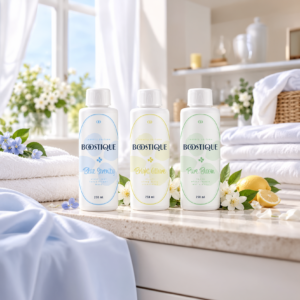
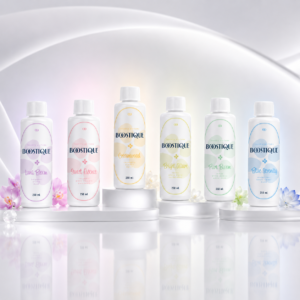
BOOSTIQUE is a brand of laundry perfumes and home fragrances that draws on the experience of Olfactory Consulting, which has been in business since 2011. The range covers a variety of fragrance profiles, from the fresh scents of Blue Serenity and Pure Bloom to the warmer, creamy, woody notes of Creamwood.
That variety is one reason why documentation needs to match the specific formula. Two fragrances can smell equally intense and still differ in their composition and conditions of use.
For a premium fragrance brand, quality goes beyond scent intensity. Responsible communication includes a clear description of what the product is for, clear dosing instructions and claims that can be backed up by documentation.
When you choose a BOOSTIQUE laundry perfume, follow the instructions on the packaging. They tell you how to use the specific formula you’ve chosen.
Frequently asked questions about IFRA
Does IFRA certify finished laundry perfumes?
No. IFRA does not issue certificates for finished products. The supplier of the fragrance mixture prepares the certificate of conformity for the specified applications.
Does compliance with IFRA Standards mean a product is allergen-free?
No. Compliance does not establish that the product is free of allergens or guarantee that an individual will not react. Check the ingredient information and warnings for the particular product.
Does a strong scent mean the product exceeds IFRA limits?
Scent intensity alone cannot answer that question. Compliance is assessed using the formula, concentration and intended application.
Can one certificate cover all products from a brand?
This depends on which fragrance mixtures, applications and limits the certificate covers. Check that they match the actual product formulas.
Do IFRA Standards replace European legislation?
No. They are a separate industry framework. Manufacturers must also meet the legal requirements that apply to the product and the market where it is sold.
Why does fragrance documentation need to be updated?
Scientific knowledge advances, standards change, and formulas or applications may also be revised. Up-to-date documentation allows you to check whether existing conditions of use still meet the relevant requirements.